What a rollup is and why Bitcoin needed one
Bitcoin is the most secure network in the world, yet it processes only around seven transactions per second. Rollups offer a way to scale without sacrificing the security of the base layer.
«Due Diligence of a Layer 2 – The Bitcoin Hyper Case» Volume I — first edition, July 2026.
Buy on Amazon →Latest article · 10 October 2026
Network and RPC announced, six planned milestones and clarifications on the HYPER test tokens on Ethereum and Solana.
Read the article →523
Pages, Vol. I
24
Chapters, Vol. I
36
Chapters, total
21B
$HYPER supply
Three profiles, three approaches. Choose your entry point.
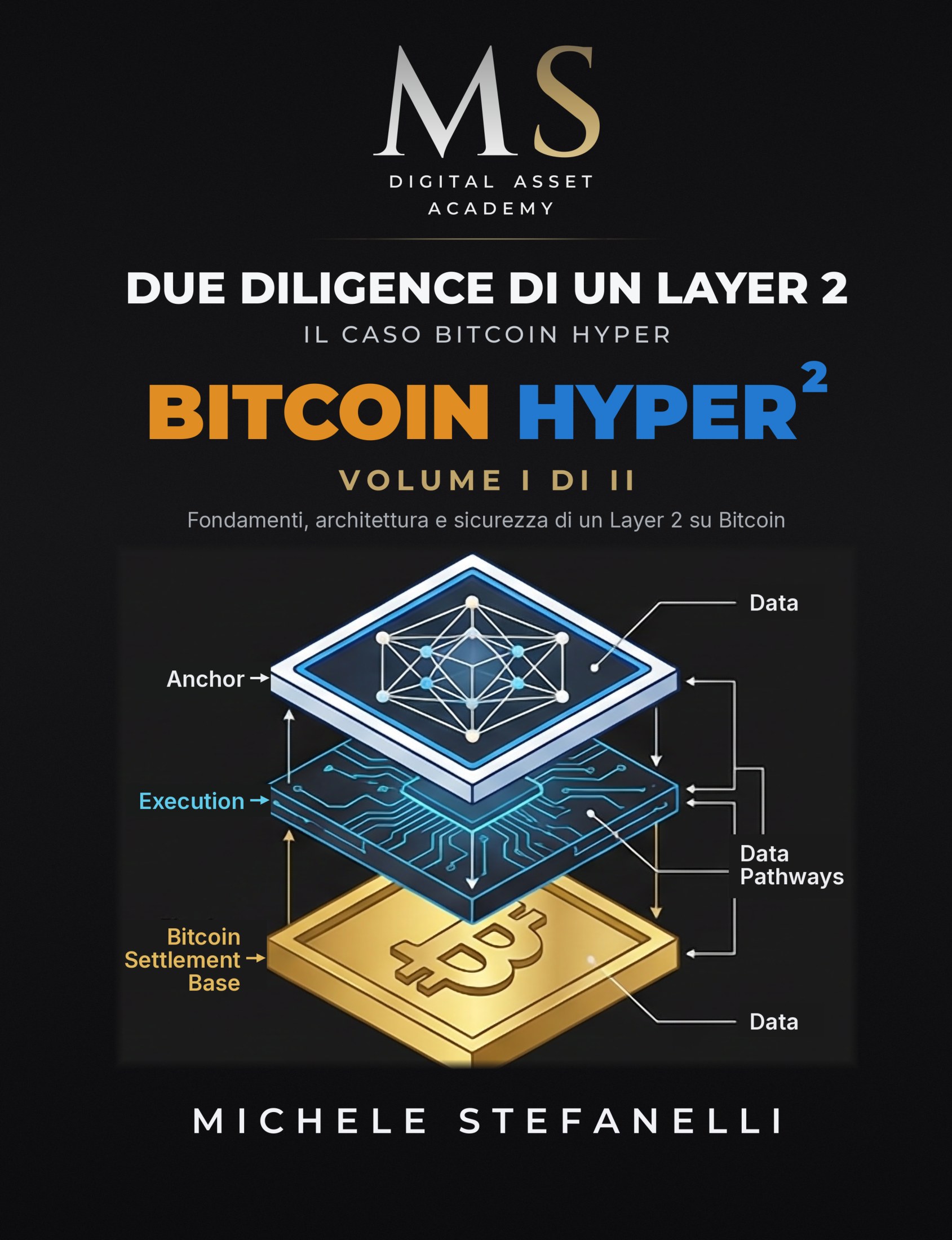
The project presents Bitcoin Hyper as a Layer 2 rollup anchored to Bitcoin and designed to use the Solana Virtual Machine (SVM) as its execution environment. Its stated aim is to inherit Bitcoin's security while delivering Solana-like transaction throughput.
The architecture is organised into three distinct layers:
Bitcoin (Layer 1) — Settlement
Each batch of transactions is anchored to Bitcoin via OP_RETURN or Taproot. Bitcoin's security guarantees the immutability of the state.
Hyper Rollup (Layer 2) — SVM execution
The heart of the system. The sequencer collects transactions, executes them in the SVM/Sealevel environment (with native parallelism), and periodically publishes the state root to Bitcoin.
Applications (Layer 3) — DeFi and beyond
DeFi, NFTs, DEXs, lending, gaming, oracles, SPL tokens. Any program compatible with the Solana toolchain can run on Hyper with no substantial changes.
SVM — Solana Virtual Machine
Sealevel enables the parallel execution of thousands of non-conflicting programs. Solana developers can port Rust/Anchor programs to Hyper with minimal changes.
Sequencer — present and future
At launch: centralised (censorship risk, single point of failure). Roadmap: decentralisation through rotation and auctions. One to watch.
Canonical bridge BTC↔Hyper
In testing on the devnet. The forced exit mechanism (guaranteed withdrawal) is not yet finalised. A pre-mainnet priority.
Data availability — an open question
A definitive solution is still under research (Mar 2026). Options: an external DA layer (Celestia), sharding, erasure coding. A material technical risk.
RPC Testnet
The team has announced the testnet RPC and a progressive rollout of explorer, wallet, faucet, bridge and staking. Our independent observatory reads network activity without requiring a wallet.
A total supply of 21 billion, deliberately mirroring Bitcoin. Data from the whitepaper — some vesting details were not yet finalised as of 14 May 2026.
A reserve for the protocol's future development and operations
Partnerships, ecosystem growth, exchange listings
The core team and technical contributions. Schedule not published
⚠ Vesting not finalised
Staking and incentives for validators and liquidity providers
Market making and liquidity for centralised exchanges
A 7-day cliff from the TGE. Percentage details not public
⚠ To be verified
⚠ Editorial note: The tokenomics data in this section come solely from the information published on the official site bitcoinhyper.com/it and its official whitepaper. As of 14 May 2026, the vesting details for the team and investors had not been officially published. Always consult the due-diligence checklist before making any decision.
Source: «Due Diligence of a Layer 2 – The Bitcoin Hyper Case» (Michele Stefanelli) + official updates
News · Bitcoin Hyper Testnet
The team announced a phased release over six weeks. The announced schedule and verified availability are shown separately.
Available · Testnet network and RPC
In developmentRelease planned in the team’s programme · Explorer → Wallet → Faucet → Bridge → Staking dashboard
Green: RPC verified reachable. Yellow: planned release, not yet verified available. “In development” describes the announced programme, not a technical check of development.
Weeks are relative to the team’s announcement, not firm dates. This programme is separate from the 2027 roadmap.
View the full schedule →Current phase
Testnet
Public RPC · Progressive rollout
Planned mainnet
Q2 2027
Planned · Sources checked: 2026-10-10
Audits · historical assessment
Not yet
Promised before the TGE
RPC Testnet
Available
Network observation through RPC
Launch of the official website, branding, whitepaper v1, assembly of the core team, community building on X/Telegram/Discord
Presale and staking phase: Q2 2025–Q2 2027 (page 6). Presale completion is expected in Q2 2027, depending on market conditions and demand (page 12).
SVM programs running natively, a live explorer, and DeFi/SPL/multisig testing with selected developers
A first audit of the smart contracts and the bridge is under way. The project states that the results will be published on the official website before the TGE.
The BTC↔Hyper bridge is in testing on devnet, with a forced-exit mechanism in development. The bridge is intended to be decentralised and non-custodial.
The team has announced the testnet RPC and a progressive rollout of explorer, wallet, faucet, bridge and staking. Our independent observatory reads network activity without requiring a wallet.
Mainnet objective: Q2 2027 (page 6). A planned Layer 2 launch with bridge, SVM and dApps; testnet RPC availability does not confirm mainnet launch.
Listing target: Q2 2027 (page 14), subject to presale completion and market conditions. Page 6 also includes listings in Q3: timing needs reconfirmation. CEX names require official announcements.
Q3 2027 objective (page 6): developer toolkit, SDK/API, partner projects and initial DAO framework. Listings have a separate Q2 target elsewhere in the document.
Q4 2027 objective (page 6): DAO proposals and voting, incentives for operators and developers. A planned phase, not proof of achieved decentralisation.
Technical articles and critical analysis. Key claims are supported by identifiable sources.
Bitcoin is the most secure network in the world, yet it processes only around seven transactions per second. Rollups offer a way to scale without sacrificing the security of the base layer.
Why did Bitcoin Hyper choose Solana's SVM as its execution engine? A guide for those who know Bitcoin but have never touched a smart contract.
Every major rollup (Arbitrum, Optimism, Base) launched with a centralised sequencer. Is this an acceptable risk or a warning sign?
Technical-analysis episodes. Ideal for going deeper on the move.
Available now
Volume I of II · 523 pages · 24 chapters · MS Digital Asset Academy
Volume I — Foundations, architecture and security of a Bitcoin Layer 2
Michele Stefanelli · MS Digital Asset Academy
This first volume — the volume devoted to understanding the system — reconstructs the project's architecture one question at a time, following a method set out at the start and held to the final page.
The team's claims are treated as statements to be verified, facts as facts, and the distance between the two as the object of the inquiry. Twenty-four chapters, each built around concrete analogies, questions and answers, and a concise summary at its close. Judgement — tokenomics, risks, comparison with other Layer 2s — is the task of Volume II.
Measured, well-documented and independent analysis of Bitcoin Hyper, Bitcoin Layer 2s, MiCA regulation and digital-asset due diligence. Regulatory alerts, technical updates on the projects we monitor, and editorial news from MS Digital Asset Academy. Get project updates. No spam. You can unsubscribe at any time.
No commitment. Unsubscribe in one click.
MS Digital Asset Academy · Editorial news
Volume I is available
Due Diligence of a Layer 2 – The Bitcoin Hyper Case
523 pages · 7 parts · 24 chapters · First edition July 2026
MS Digital Asset Academy · Editorial news
Volume I is available
Due Diligence of a Layer 2 – The Bitcoin Hyper Case — 523 pages · July 2026
MS Digital Asset Academy · News